
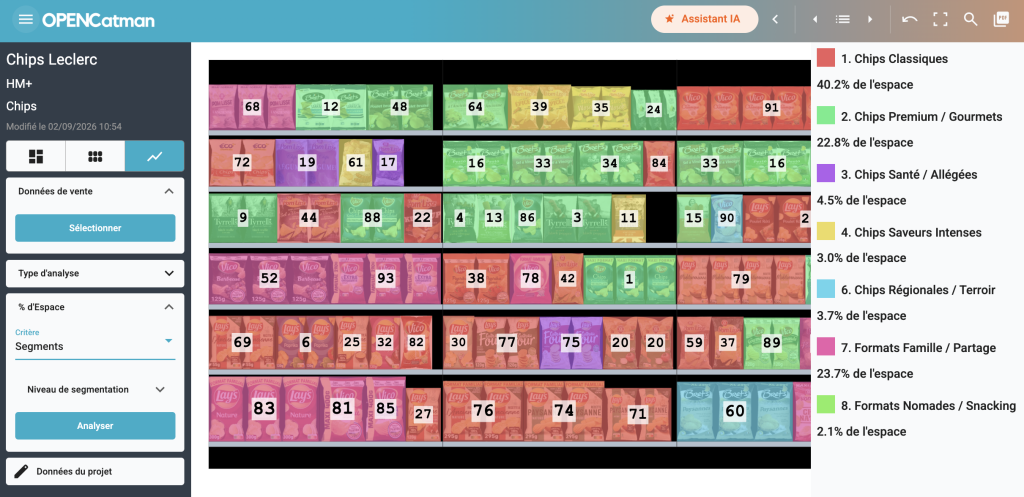
Defining an assortment is one of the most strategic decisions in Category Management. It’s not just about choosing products: it’s about building a coherent, profitable offer aligned with the shopper’s real needs. To achieve this, it’s essential to follow a structured process that analyzes the category from its smallest components to its overall impact at the point of sale.
In this article, I’ll explain how to do it step by step, with a clear methodology applicable to any category, and how artificial intelligence — especially through OPENCatman — simplifies and speeds up this process.
1️⃣ Segmenting the Category: The Mandatory Starting Point
Assortment analysis should never be done at the total category level. This is one of the most common mistakes.
The first step is to segment the category according to the different types of existing products, their characteristics, and their uses.
For example, in the Water category, segmentation could include:
- Mineral waters
- Spring waters
- Flavored waters
- Bottle, can, or multipack formats
Each of these levels represents a distinct consumption need. That’s why the analysis must be carried out segment by segment, avoiding mixing products that don’t compete with each other.
2️⃣ Analyzing the Existing Assortment: Identifying the Essentials
Once segmentation is defined, the next step is to analyze the current assortment. To do this, products are listed in descending order of sales.
This is where the well-known 80/20 rule comes into play:
20% of products generate 80% of sales.
That 20% forms the essential core of the assortment.
The analysis focuses on the remaining 80%, which contributes only 20% of sales and is where optimization opportunities lie.
3️⃣ Deciding Which Products to Keep or Remove
The decision to keep or remove products depends on several strategic and operational factors.
🎯 Category Role
The role defines the breadth and depth of the assortment:
- Destination → broad assortment, high tolerance for low-rotation products
- Routine → stable assortment, focus on rotation
- Convenience → reduced assortment, focus on speed
- Seasonal → temporary assortment, high rotation
🧭 Strategy Applied to Each Segment
Each segment can have a different strategy:
- Cash
- Traffic
- Territory Defender
- Premium
- Innovation
These strategies determine which products are critical and which can be dispensable.
📊 Objective Data
- Sales
- Margin
- Rotation
- Market comparison
- Duplication or cannibalization
👤 Subjective Data
- Brand strength
- Target shopper
- Consumption trends
- Strategic relevance
Combining these criteria makes it possible to precisely determine which products can be removed from the assortment without affecting actual demand.
4️⃣ Incorporating Total Market Data: Validating and Detecting Opportunities
If total market sales statistics are available, the same analysis is performed to identify:
- The essential products of the segment
- High-potential references
- Opportunities to add (new additions)
This makes it possible to assess whether the current assortment is aligned with real market demand and to detect growth opportunities.
5️⃣ How AI and OPENCatman Transform This Process
Traditionally, this analysis requires hours of manual work, spreadsheets, and complex comparisons.
Thanks to the artificial intelligence built into OPENCatman, the process becomes fast, automatic, and much more accurate.
⚙️ From an Existing Project
- Dispensable products are automatically identified.
- Duplicates and low rotation are detected.
📥 When Uploading a Market Sales Spreadsheet
- Addition suggestions are generated through direct comparison.
- The sales potential of each new reference is calculated.
- Products are integrated directly into the category’s planogram.
The result is an optimized assortment, justified, aligned with the shopper, and ready to execute in store.
🧠 Conclusion
Defining an assortment is a strategic exercise that combines analysis, shopper knowledge, and business vision. Proper segmentation, sales analysis, and consideration of the category’s role are essential for building a solid offer.
Today, thanks to tools like OPENCatman, this process can be carried out with greater precision and in a fraction of the time, allowing teams to focus on strategy rather than operational workload.