
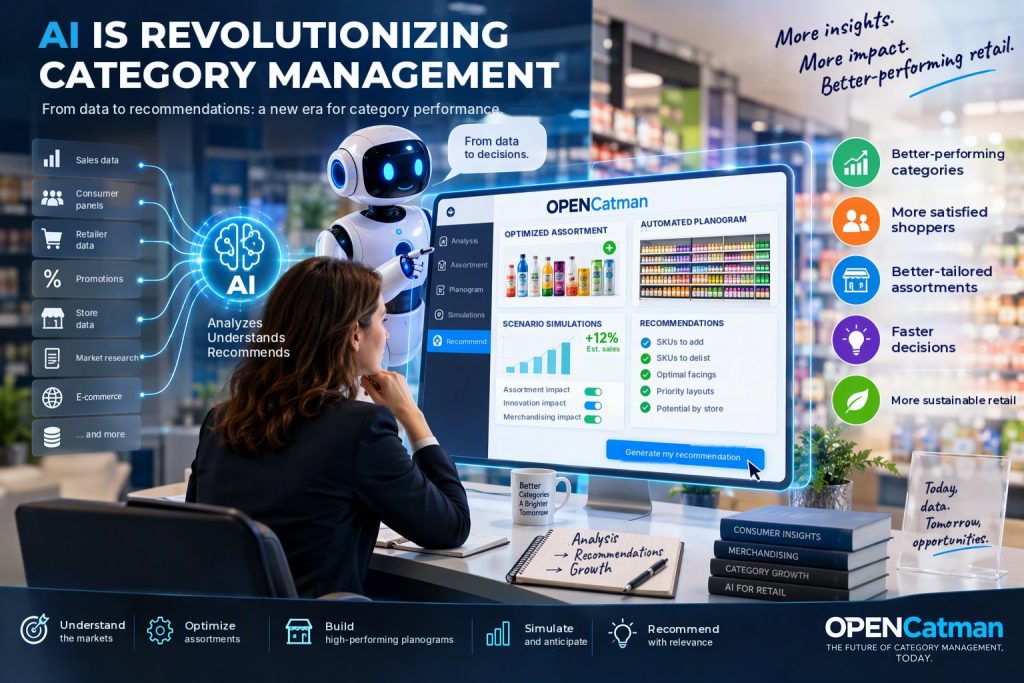
For decades, Category Management has relied on human expertise, data analysis and in-depth consumer knowledge to optimize assortments, shelf layouts and category performance. Today, Artificial Intelligence is taking this discipline to a whole new level.
Far from replacing the category manager, AI makes them faster, more accurate and more relevant. The most time-consuming tasks are automated, while recommendations become smarter and easier to act on.
Instant data analysis
One of the main challenges of Category Management is making sense of an ever-growing volume of data: retail panels, consumer panels, sales data, CRM, merchandising information, market research, e-commerce data and more.
Where analyzing this information used to take hours or even days, AI can now process and interpret it in a matter of seconds.
For example, instead of simply noting that a category has lost 4% of its revenue, AI can immediately pinpoint the causes of the decline:
- loss of distribution in certain retail chains;
- slower rotation of certain SKUs;
- changing shopping behaviors;
- increased promotional pressure from competitors.
The result: faster analysis and better-informed decisions.
Smart store clustering
Not all stores have the same potential.
With AI, it becomes possible to automatically cluster hundreds or thousands of stores based on:
- their revenue;
- their growth potential;
- their shopper profile;
- their competitive environment;
- their regional specificities.
Each store can then benefit from an assortment and merchandising strategy perfectly tailored to its commercial reality.
Assortments tailored to each catchment area
Building a high-performing assortment is a complex exercise. Between innovations, space constraints and consumer expectations, there are many trade-offs to make.
AI can now automatically recommend:
- which SKUs to add;
- which products to delist;
- the most promising innovations;
- the best-suited formats for each retail banner;
- specific assortments based on store type and location.
This approach makes it possible to move from a one-size-fits-all assortment to a true Geo-Category Management strategy.
Higher-performing planograms
By analyzing product performance, shopping behavior and the physical constraints of the shelf, AI can recommend the most effective layouts.
It can determine:
- the optimal number of facings;
- the ideal position for each SKU;
- the categories to strengthen;
- the products that could be repositioned or removed.
The goal is simple: maximize shelf performance and profitability while improving the shopper experience. With AI, this goal becomes achievable, store by store.
The power of simulation
One of the most striking contributions of AI is its ability to simulate different scenarios.
A few seconds are enough to answer questions such as:
- What happens if we remove the bottom 10% of SKUs?
- What is the potential impact of an innovation?
- How much additional revenue can we generate with two extra facings?
- What will be the consequence of reducing the assortment?
These simulations make it possible to anticipate results before any change is implemented.
A new way to talk to your data
AI is also transforming the way category managers access information.
There is no longer any need to master complex tools or build sophisticated analysis tables.
You can simply ask questions such as:
- What are my best-sellers?
- Which products should be delisted?
- Which stores have the highest growth potential?
- What strategy do you recommend to grow this category?
AI turns data into recommendations that sales, marketing and category management teams can act on immediately.
AI connected to OPENCatman
The real revolution lies not only in Artificial Intelligence itself, but in its direct connection to business tools.
The goal is to connect the full power of AI to OPENCatman’s data, processes and features in order to radically transform the way Category Management strategies are built.
Imagine simply asking:
“Create an optimized planogram for supermarkets of 1,000 to 2,000 m² and automatically generate the corresponding planogram.”
The aim is then to let AI automatically carry out:
- the category performance analysis;
- the identification of opportunities;
- the product selection;
- the assortment build;
- the planogram generation.
Combined with OPENCatman, AI no longer just analyzes data. It becomes a true Category Management assistant, able to support manufacturers and retailers in their day-to-day decisions, with a tangible result: an optimized planogram for each store, ready to implement.
A new role for the Category Manager
AI does not replace human expertise. On the contrary, it allows Category Managers to devote more time to strategic thinking, innovation and collaboration with their business partners.
Their value will no longer lie in producing analyses, but in their ability to interpret recommendations, lead transformations and create new growth opportunities.
Category Management is thus taking shape around a collaboration between human intelligence and artificial intelligence. And with AI integrated into OPENCatman, this future is already becoming a reality.